
That title caught your attention, didn’t it?
Mike Vealey has been my friend, co-conspirator, and traveling foodie companion since before his grown daughters were born. Recently, planning a trip to Great Britain, we both anticipated the same culinary challenge: Haggis!
Scotland’s national dish stands as an object of gastronomic legend, speculation, and even notoriety. In its traditional preparation, haggis consists of cooked sheeps’ “pluck”– heart, liver, lungs—diced and mixed with onions, roasted oatmeal, suet, and spices; sewn-up inside a sheep’s stomach, and boiled until reaching the consistency of a thick pudding or meat loaf. Customarily served with neeps and tatties–bashed rutabagas and mashed potatoes–haggis uses less desirable organ meat to make a savory, filling protein.
Other cultures and nationalities have similar thrifty-minded dishes. Scrapple is a close relative; so is kishke, made from stuffed beef intestines. But haggis has a reputation, and Mike and I didn’t see how we could go to Scotland and not try it.
Mike didn’t wait to reach Scotland. In the club car on the Caledonian Sleeper, a marvelous overnight train from London to Inverness, he braced himself with the requisite “wee dram” of smoky, peaty Laphroaig Scotch and ordered the haggis. It was an act of courage and dedication that went well beyond simply scarfing down a plate of stewed sheep offal: In his everyday life, Mike was a vegan!

As the Caledonian Sleeper rocked and rattled northwards, I stole a taste from Mike’s plate and found the notorious viand to be…well, pretty much mild and almost disappointingly inoffensive.
Arriving in Inverness, often called the “Gateway to the Highlands”, we immersed ourselves in Scottish lore and legend. We cruised Loch Ness (without seeing “Nessie”, always referred to by name and as a “she”!), climbed the battlements of Urquhart Castle, and tried to roll our “Rs” to correctly pronounce ”Drumnadrochit”, a lovely lochside village.
Haggis is ubiquitous throughout Scotland. Nearly every restaurant, supermarket, and fast food joint I saw stocked the dish, sometimes deep fried, and most frequently cooked in a synthetic sausage casing. Some versions used beef or pork; some even used bison. Some shops offered haggis in tins or a container to be cooked in a conventional oven or a microwave. I found haggis flavored potato chips, canned haggis, haggis flavored chocolate, a haggis burger served on a bun, haggis pakora in Indian restaurants, and haggis used as an ingredient in pizza. Even a Kosher haggis.
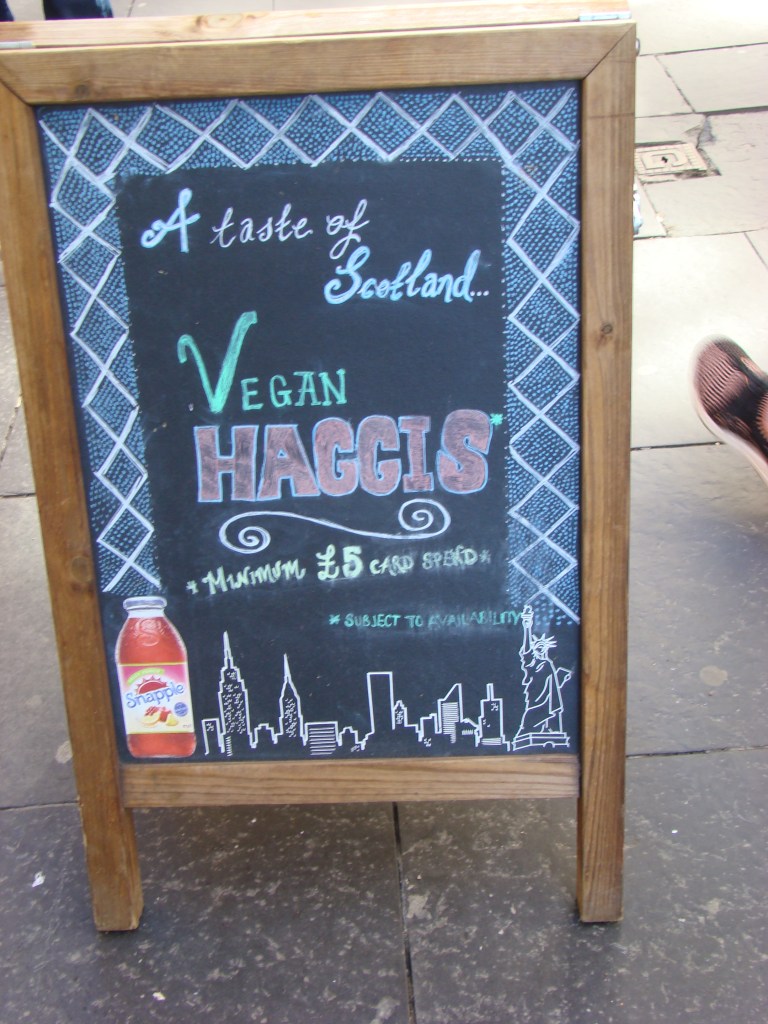
Vegetarian haggis, often made from legumes, nuts, and vegetables, has become relatively common. However, the most unusual preparation must be vegan haggis, offered in a shop off of Edinburgh’s Royal Mile.
My turn to order the haggis in Scotland came in a lunch spot near the Inverness castle. I really had to try haggis within the Highlands. What if the dish as served to Mike on the Caledonian Sleeper was not quite authentic? After all, we were still in England at that time. Meeting the haggis challenge required authenticity.
The waitress presented to me a plate holding three mounds: one white, one yellow, and one brown, looking like they had been doled out with an ice cream scooper. The white was potatoes, the yellow was turnips, and the brown was haggis. Again, I found it to be mildly flavored and “earthy” tasting, vaguely like scrapple or chopped liver. The haggis wasn’t bad; but, I loved the neeps and tatties!

 Back to What We're Having
Leave a comment