Rediscovering the Chesapeake’s Chiles
A recent Associated Press headline announced that the Guinness Book of World Records declared a new World’s Hottest Hot Pepper, Pepper X, eclipsing the previous ne plus ultra– Carolina Reaper–by almost twice the heat. But, just how hot is that? How do you even measure something as subjective as a taste, and that taste in particular?
Peppers’ heats are measured in Scoville Heat Units (SHUs, or “Scovies”), named after American pharmacist Wilbur Scoville. He developed the Scoville organoleptic test, a method to quantify a pepper’s fieriness. Zero is bland; a jalapeno pepper peaks around 5,000 SHUs; a habanero tops 100,000; and the ex-champ, Carolina Reaper, was pegged at 1.64 million SHUs, still way behind Pepper X’s 2.69 million SHUs.
But, for all of the heat it packs, Pepper X still can’t compete with a Chesapeake favorite—the fish pepper—for beauty, culinary utility, and a tradition that began 2 centuries ago.
Coming to Baltimore
No one knows the exact origins, but culinary historians believe fish peppers came from somewhere in the Caribbean, possibly Haiti, early in the 1800s. When they reached Baltimore, they easily grew and thrived in gardens primarily in the African American community; handed off as gifts, traded, or in barter. With heat similar to a jalapeno—5,000 to 30,000 Scovies–and texture like a serrano, the peppers worked well with the Chesapeake’s bountiful seafood; hence, the name fish peppers.
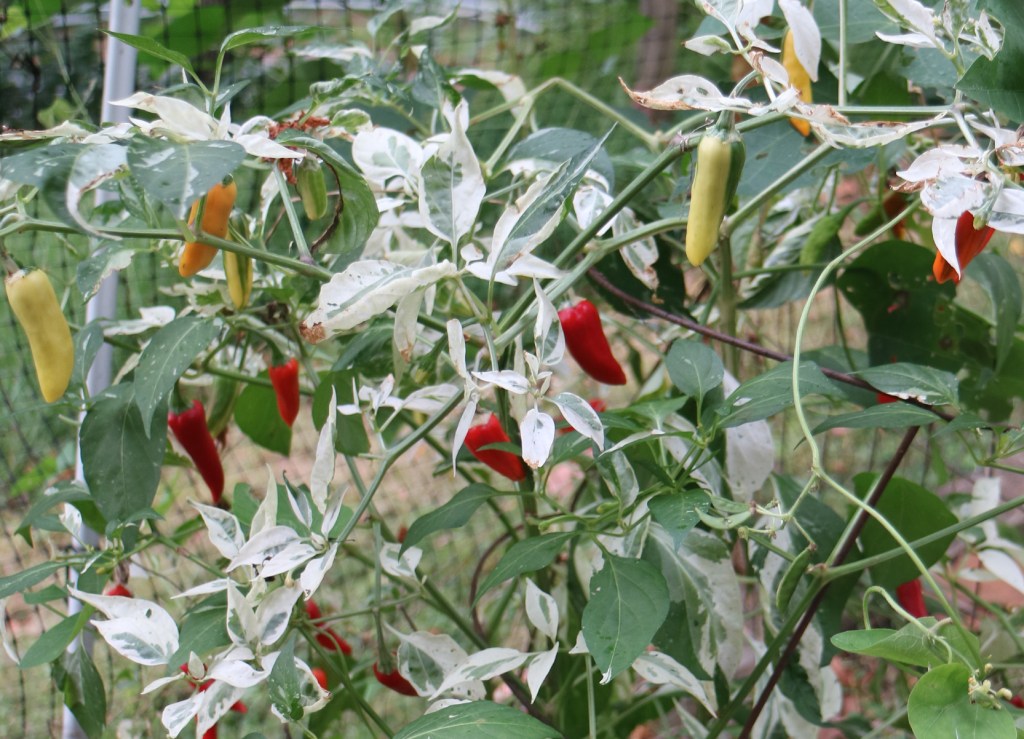
A singular characteristic, the pepper’s color evolves as the fruit matures, changing from milky white to yellow to striped green to intense red. African American chefs favored the peppers for the sweetly spicy flavor, temperate heat without bitterness, and their usefulness in recipes that had a cream base. The lighter colored fish peppers would not discolor the white sauces.
Fish peppers also served as a home remedy for joint pain and were even applied to tobacco plants to keep bugs away. Escaping enslaved people are said to have disguised their scent by rubbing fish peppers on their feet to throw off the dogs who tracked them.
Gone from the Gardens
Fish peppers became almost exclusively a Baltimore thing. But, by the early 1900s, as more people moved away from agricultural life, the fish pepper—once a garden staple—waned in popularity and nearly became extinct. The case can be made that one man—an African American painter named Horace Pippin—kept that from happening.
Wounded in World War I, Pippin also suffered from arthritis and used a then popular remedy–bee stings—for relief. He traded some of his seeds for bees from a neighboring beekeeper who saved the seeds. In 1995, William Woys Weaver, an internationally known food ethnographer and author, found the seeds in his grandfather’s freezer, shared them with Seed Savers Exchange (www.seedsavers.org), and the Chesapeake’s chile returned home.
Fish peppers are relatively easy to grow. Start the seeds inside and transplant seedlings outside into a sunny spot after the last frost. The plants will also do well growing in 5-gallon pots or buckets. Seeds obtained from Seed Savers Exchange and similar organizations are open pollinated, not hybrids. Save seeds from ripe peppers to grow next year’s crop. And, be sure to continue fish peppers’ tradition by gifting some seeds to a friend.

 Back to What We're Having
Leave a comment