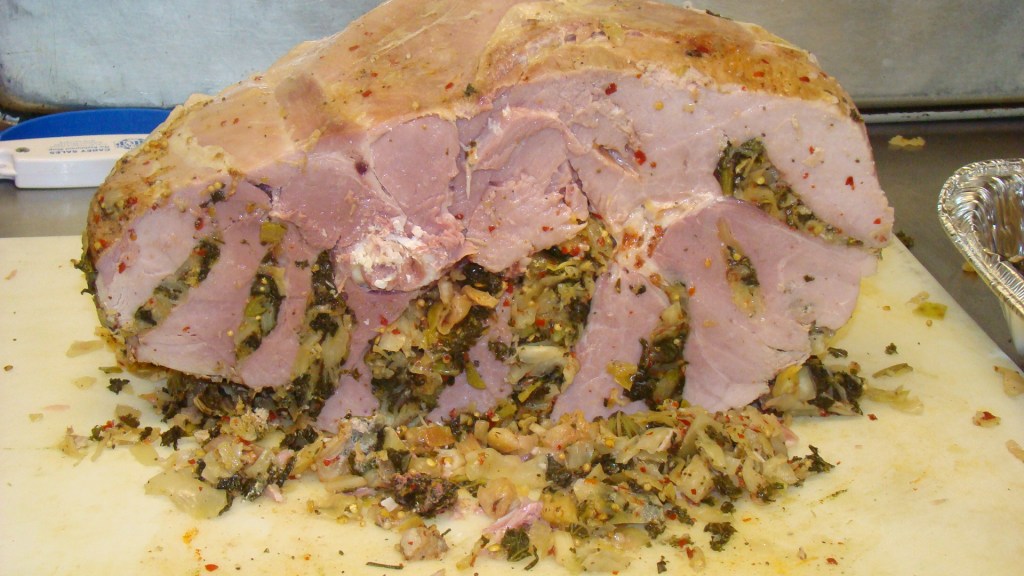
Indigenous to certain parts of Maryland’s St. Mary’s County, the stuffed ham’s history goes back almost as far as Maryland itself. During early Colonial years, priests from the local monastery routinely visited the numerous Roman Catholic settlers. To please the priests and add color and interest to an otherwise commonplace cut of meat, the parishioners would stuff a mixture of kale, cabbage, other greens, and onions into slits cut in the ham. Once the ham was boiled and cooked through, slicing it revealed an almost decorative pattern of greens running through the pinkish-tan meat.
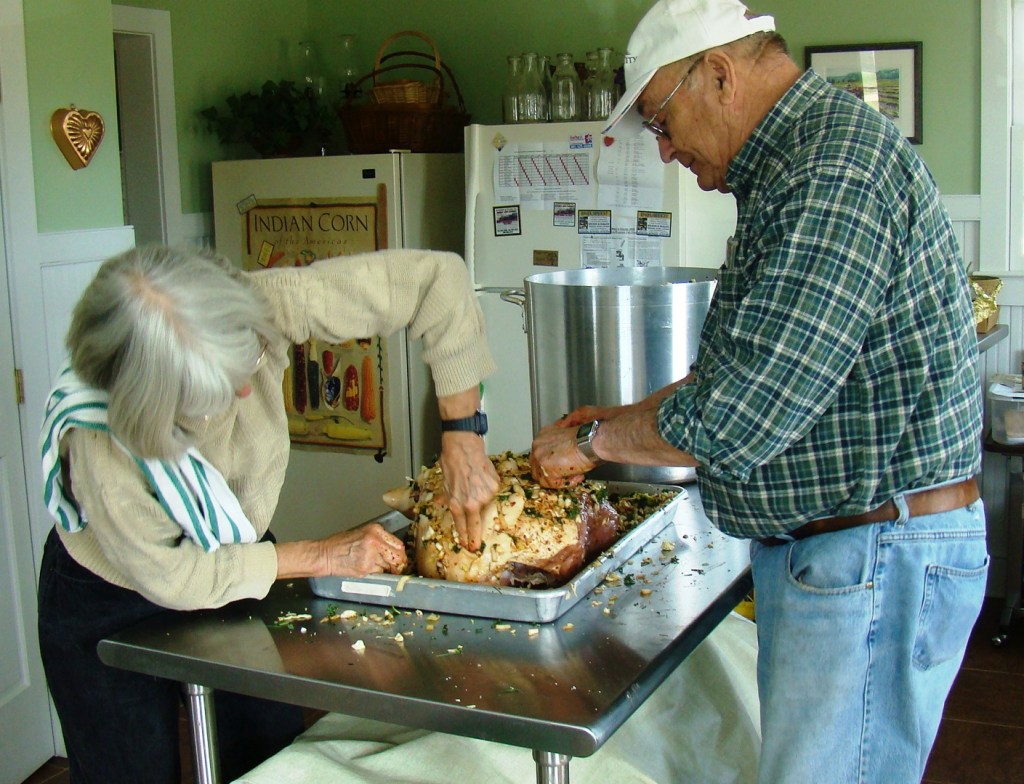
After years of searching for someone to mentor me through preparing a stuffed ham, I met Becky MacDonald and her friend Pete Himmelheber—both from St. Mary’s County–who agreed to take me through the process. Becky purchased a specially corned ham and invited me to her home to learn the traditional foodways taught to her by her father. Her one caution: I needed to bring the biggest cooking pot available.
I arrived at Becky’s home, carrying the largest pot I could buy at my local big box store. Sixteen quarts, however, wasn’t even close to big enough.
For Becky, stuffed hams were very much a family and holiday occasion. “We’ve stuffed as many as 15 hams,” she explained. “Last Christmas, we stuffed 6 hams. We had 25 people, 7 dogs, and 35 gallons of egg nog!”
Color Wars?
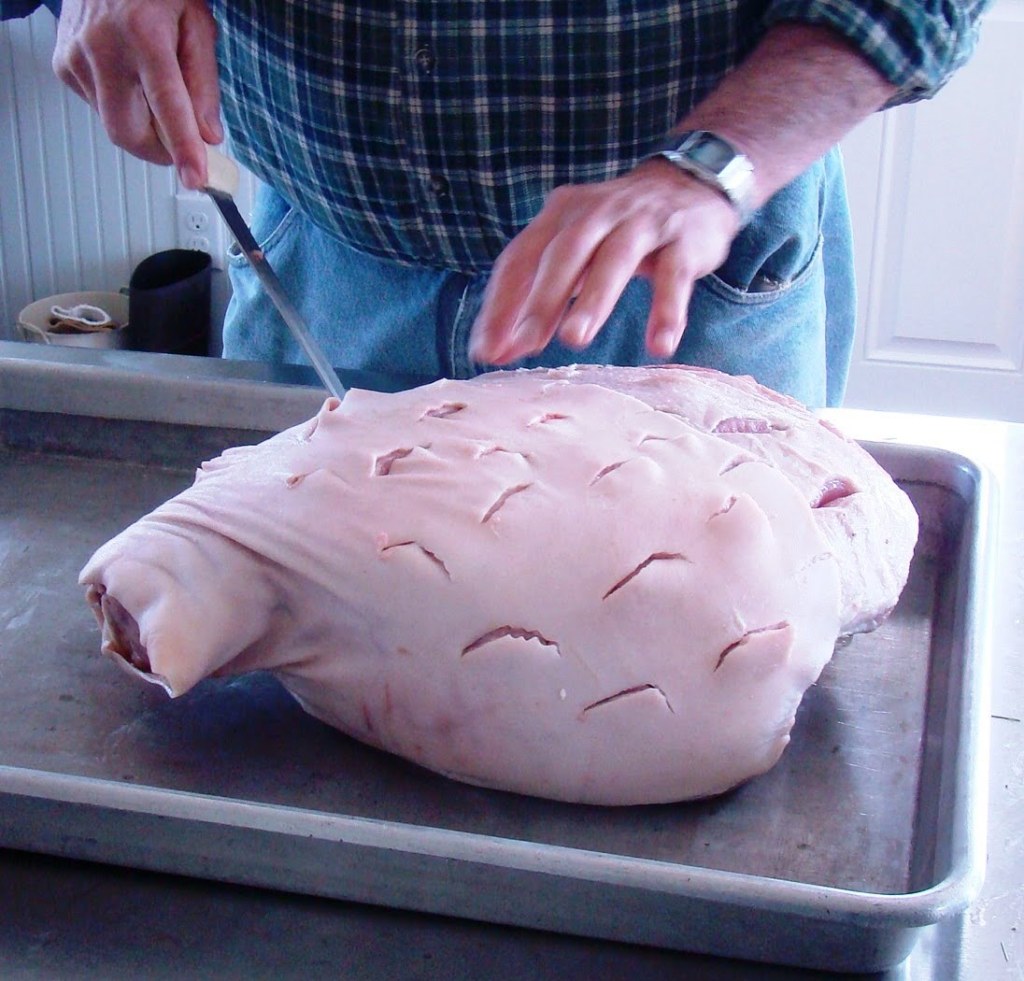
To begin the procedure, she immediately set Pete and me to chopping the vegetables for the stuffing. The idea is to use a sharp blade to poke slits deep into the meat, then stuff the chopped vegetable mix into those slits. A 25-pound ham is big, and we had to pack about 10 pounds of seasoned stuffing into it–a messy, finger-wrenching chore. All the while, Pete and Becky critiqued the stuffing’s color: “A little more kale, I think. Over in Ridge (MD), they use celery and make it too white. It should be a third, a third, and a third.”
After a full morning of chopping, piercing, and packing, Becky wrapped my stuffed—but yet uncooked–ham in a double layer of cheesecloth so I could boil the ham at my home. As I swaddled it inside three plastic garbage bags for the journey back to Granite, Becky advised that I find a crab pot to use to boil the ham.
It took me the rest of that day and part of the next to discover that stores do not stock crab pots in early March. Meanwhile, the ham was too big to spend the night in my refrigerator. Fortunately, it was cool enough outside to store the ham on the deck overnight, but first I had to build a sturdy barricade to discourage any raccoons, foxes, or other raiders.
Finally, a Pot Big Enough
I located a 60-quart stockpot for sale at a regional sporting goods outlet. Complete with a spigot, the pot was certainly big enough. It was also expensive, but I had this ham, out on the deck, guarded only by a pile of lawn chairs…
I brought the pot home, plunked the ham into it, and hoisted the whole thing onto my stove, ignoring the obvious fact that the pot dwarfed the largest burner. I had to carry water from the tap to fill the pot just above the ham. As the burner came up to temperature, the kitchen suddenly filled with steam and smoke! The spigot on the stockpot leaked, flooding into the stove’s electric burners. I had to use the leaky spigot to drain the heavy pot before I could even move it off the stove.
The ham spent yet one more night, forted-up outside on the deck.
The next day, I did what I should have done first off: I called Jay Angle, owner of the Salsa Grill on Security Boulevard. He graciously took charge of the ham, cooking it, draining it, cooling it, and slicing it in his restaurant. He even took pictures for me.
All I had to do was return that miserable 60-quart stockpot.
St. Mary’s Stuffed Ham, Leonardtown Style
25-pound corned ham
4 big onions (3 pounds)
4 to 5 medium heads of cabbage
Kale, “a grocery bag, packed down”
Spring onions, “small amount”
2 tablespoons black pepper
1/2 to 3/4 cups salt
1 1/2 ounce celery salt
1/2 to 1 cup crushed red pepper
Chop the onions, cabbage, and kale to 1/2 to 1-inch pieces. Mix in the rest of the ingredients except the red pepper. Only mix in half the red pepper and then taste. Add more to taste. Thoroughly mix the stuffing, tasting and adjusting the seasoning. Make it overly spicy; the stuffing will season the meat.
Pierce rows of narrow, crescent-shaped slits deep into the meat, but not all the way through. Using your hands, push the stuffing tightly into the slits. Stuff all of the slits as fully as possible. Wrap the stuffed ham tightly in double layers of clean cheesecloth or light cotton. Place in a large pot, cover with water, and low boil for about 20 minutes per pound. Remove from the pot and let the ham drain overnight; remove the cloth and skin. Slice to show off the stuffing.

 Back to What We're Having
Leave a comment